Machine Learning Models in Loan Origination Risk Assessment
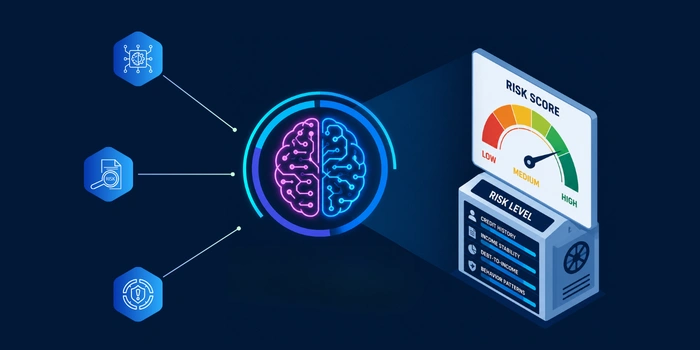
It's an exciting time for the lending industry as financial institutions have begun to deploy Machine Learning (ML) models in Loan Origination Risk Assessment. Evaluating credit risk typically entails a combination of limited financial data and manual processes, which can be time-consuming and prone to inaccuracies. With the growing demand for faster loan approvals and improved credit decisions, Loan Origination Software(LOS) powered by Artificial Intelligence (AI) and Machine Learning is becoming an essential tool for banks, NBFCs, microfinance institutions, and digital lenders.
Understanding Risk Assessment in Loan Origination
One of the most important phases of the loan origination is risk assessment. Determines if the borrower will repay the loan on time and helps lenders to minimize non-payment. Conventionally loan officers reviewed the credit score, income statement, work history, and financial details of applicants. These practices are effective in some ways, but have drawbacks, particularly in their inability to represent complex patterns and new risk signals.
Machine Learning takes this a step further by analyzing huge amounts of structured and unstructured data to uncover hidden trends, forecast borrower conduct, and boost decision-making precision.
How Machine Learning Models Enhance Loan Risk Assessment
The Machine Learning models employ historical lending information, customer behavior patterns, transaction history, repayment history, and other data sources to forecast a customer's creditworthiness. In contrast to traditional scoring systems, ML algorithms continuously learn from new data, to make more accurate and dynamic risk assessments.
The most popular Machine Learning models that are used in a loan origination system include:
1. Logistic Regression
Logistic Regression is commonly adopted for predicting loan default. Helps lenders to categorize applicants as low-risk and high-risk by considering various financial factors.
2. Decision Trees
Decision Trees will help establish an organized system for analyzing borrower profiles. These models strip down the complexities in lending decision making and distinguish important variables that affect repayment rates.
3. Random Forest
Random Forest is a combination of several decision trees to gain higher prediction accuracy. It helps to avoid overfitting and ensures consistent credit risk evaluations for a wide range of borrowers.
4. Gradient Boosting Models
The models like XGBoost and LightGBM proved to be highly powerful when it comes to finding more intricate risk patterns. These models are typically applied by Digital Lending platforms to make credit decisions in real-time.
5. Neural Networks
Financial and behavioral information is enormous, and Neural Networks can handle it, making them appropriate for sophisticated lending settings. They are especially valuable for fraud identification and intricate risk analysis.
Benefits of Machine Learning in Loan Origination
Faster Loan Approvals
Machine Learning automates risk assessment, taking a long time out of the loan application process. Approval decisions can be made in minutes, not days, by the applicant.
Improved Credit Risk Prediction
ML models are more accurate than traditional credit scoring methods when they analyze several data points simultaneously and help lenders decrease non-performing assets (NPAs).
Enhanced Fraud Detection
Using Machine Learning algorithms, unusual application patterns, suspicious transactions and identity inconsistencies can be discovered, which helps minimize risk of fraudulent applications.
Better Customer Experience
Automated risk assessment allows for seamless digital lending experiences, with quicker approvals, lesser manual efforts and more borrower satisfaction.
Financial Inclusion
For borrowers with limited credit histories, alternative data sources like utility payments, transaction behavior, and digital footprints can be used to assess borrowers within the context of a loan origination system powered by machine learning. This helps to better meet the needs of those who are unbanked and underserved.
Difficulties in the deployment of Machine Learning Models
Machine Learning models are beneficial, but they do need high-quality data, the ability to be compliant with regulations and ongoing monitoring. To comply with changing compliance regulations, financial institutions need to ensure the transparency, model explainability, and security of their data.
In addition, lenders should periodically retrain models to adjust to shifting market conditions and borrower patterns in behavior.
The Future of AI-Powered Loan Origination
Digital lending is expanding and in the future, Machine Learning will be an integral tool in the credit risk assessment, loan underwriting, and loan origination automation processes. Going forward, real-time analytics, predictive modeling, and AI-powered decision engines will help to create smarter lending outcomes.
Advanced Loan Origination Software, AI-powered lending platforms, and Machine Learning-based risk assessment tools will provide a competitive edge to organizations by speeding up loan applications, reducing default rates, and enhancing operational efficiency.
Conclusion
Machine Learning models are transforming the way loan origination risk assessment is done by offering more data-driven, data accurate, and scalable processes in risk assessment. AI and Machine Learning are transforming modern lending from loan default prediction to fraud detection and customer experience. AI and Machine Learning are revolutionizing modern lending, from predicting loan defaults to detecting fraud and improving customer experiences. By adopting these technologies, financial institutions can enhance risk management, optimize operations, and contribute to the sustainable development of the digital financial market.